
Introduction
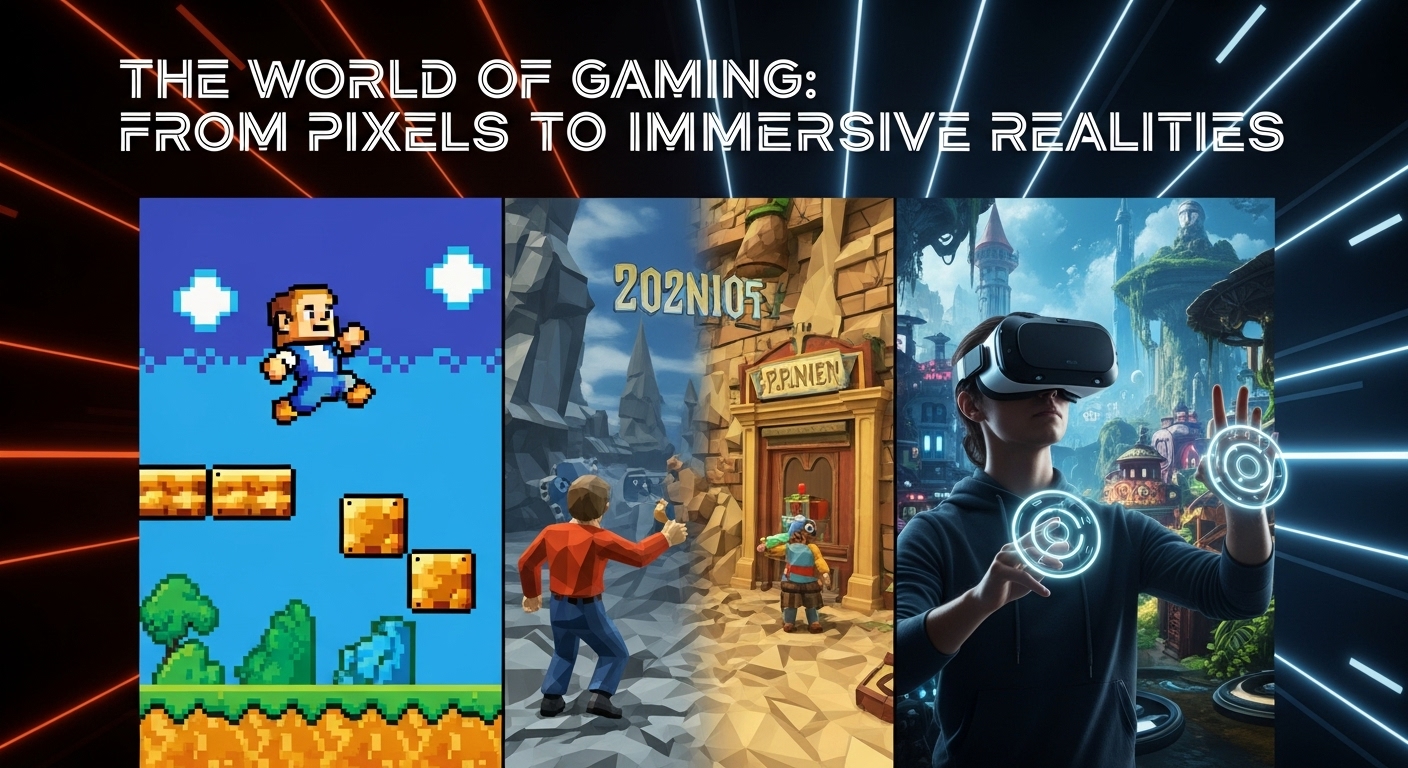
Gaming has transformed from a niche hobby enjoyed by a small group of enthusiasts into a global cultural phenomenon that connects billions of people across the world. Once seen as a pastime for children or tech-savvy teens, gaming has now become one of the most influential forms of entertainment, rivaling movies, television, and music in both popularity and profitability. From classic arcade machines and pixelated adventures to immersive open worlds powered by virtual reality, gaming has redefined what it means to play, compete, and connect. This blog explores the evolution, psychology, social influence, and future of gaming, diving deep into why it has become such an integral part of modern life.
The Origins of Gaming
The story of gaming begins in the mid-20th century, when computer scientists and engineers began experimenting with interactive electronic entertainment. Early creations like “Spacewar!” (1962) and “Pong” (1972) laid the groundwork for what would become a multi-billion-dollar industry. The 1970s and 1980s were a time of experimentation, innovation, and cultural curiosity. Arcade machines appeared in malls and entertainment centers, attracting crowds of players eager to test their reflexes and skill. The home console revolution began with systems like the Atari 2600, giving families the ability to experience video games without leaving their living rooms.
While primitive by today’s standards, these early games were groundbreaking. They established basic mechanics such as scoring, progression, and competition that remain fundamental even in modern gaming. Titles like “Pac-Man,” “Donkey Kong,” and “Space Invaders” became cultural icons, recognizable symbols of an emerging digital age. These games were simple in design yet endlessly replayable, teaching early developers the importance of gameplay balance and accessibility.
The Rise of Home Consoles
The 1980s and 1990s marked a golden age for console gaming. Companies like Nintendo, Sega, and later Sony, transformed gaming from a curiosity into a dominant entertainment form. Nintendo’s release of the Nintendo Entertainment System (NES) in 1985 revived a struggling industry after the video game crash of 1983. The NES introduced gamers to franchises that continue to thrive today, such as “Super Mario,” “The Legend of Zelda,” and “Metroid.”
The console wars between Sega and Nintendo in the early 1990s brought fierce competition and rapid technological progress. Sega’s “Sonic the Hedgehog” challenged Mario’s supremacy, while Nintendo’s innovative game design and family-friendly approach solidified its dominance. When Sony entered the scene with the PlayStation in 1994, gaming began its transition into 3D environments, forever changing how games looked and felt.
The late 1990s saw the emergence of immersive storytelling and cinematic gameplay. Titles like “Final Fantasy VII,” “Metal Gear Solid,” and “Resident Evil” pushed the boundaries of what players could experience. For the first time, games could evoke deep emotions, suspense, and empathy, blending narrative with interactivity in a way that no other medium could match.
The PC Gaming Revolution
While consoles were popularizing gaming among mainstream audiences, personal computers were creating a parallel universe of innovation and complexity. PC gaming in the 1990s and early 2000s became a hub for genres like real-time strategy, simulation, and first-person shooters. Games such as “Doom,” “StarCraft,” and “The Sims” demonstrated the flexibility and depth that PCs offered.
PC gaming also laid the foundation for online multiplayer experiences. Titles like “Counter-Strike,” “World of Warcraft,” and “EverQuest” connected players from around the globe, building virtual communities long before social media existed. These games introduced new concepts of teamwork, social hierarchy, and competition that would later define modern esports.
Moreover, PCs allowed modding — user-created modifications that added new content or mechanics to existing games. This not only extended a game’s life span but also empowered players to become creators. Many modern game developers began their careers as modders, learning design principles by tinkering with existing titles.
The Emergence of Mobile and Casual Gaming
The 2000s brought a new revolution with the rise of smartphones and tablets. Gaming was no longer limited to expensive consoles or high-performance PCs; it was now available in everyone’s pocket. Mobile games such as “Angry Birds,” “Candy Crush Saga,” and “Clash of Clans” reached audiences who had never considered themselves gamers before.
Mobile gaming introduced simplicity and accessibility, allowing people to play in short bursts during commutes or breaks. It also demonstrated the power of the “freemium” model, where games were free to play but offered in-app purchases for customization, progression, or convenience. This model fundamentally changed how games were monetized and developed.
Today, mobile gaming represents the largest segment of the gaming industry by revenue. It has opened doors for developers worldwide and made gaming more inclusive than ever before. From children to grandparents, nearly everyone has played a mobile game at some point, proving that gaming transcends age, culture, and gender.
The Social Dimension of Gaming
Gaming is no longer a solitary activity. Modern multiplayer experiences, streaming platforms, and online communities have turned gaming into a social ecosystem. Players now collaborate, compete, and communicate in real time, forming friendships that often extend beyond the screen.
Platforms like Discord, Xbox Live, and PlayStation Network have made communication seamless, while streaming services allow players to broadcast their gameplay to millions of viewers. Games like “Fortnite,” “Apex Legends,” and “Call of Duty: Warzone” are not just competitive shooters — they’re social spaces where players hang out, attend virtual concerts, and share experiences.
This social aspect has also given rise to esports, where professional players and teams compete for fame and fortune. Esports tournaments now fill stadiums, attract sponsorships, and offer prize pools worth millions of dollars. Games such as “League of Legends,” “Dota 2,” and “Counter-Strike: Global Offensive” have created global fanbases comparable to traditional sports.
The Psychological Impact of Gaming
Gaming’s influence extends beyond entertainment. It has significant psychological and cognitive effects, both positive and negative. On the positive side, games can enhance problem-solving skills, spatial awareness, and hand-eye coordination. Strategy and puzzle games encourage critical thinking, while cooperative play fosters teamwork and communication.
Gaming can also provide emotional and psychological relief. Many players use gaming as a form of escapism or stress management, finding comfort and control in virtual worlds when real life feels overwhelming. Role-playing games, in particular, allow players to explore different identities, make moral choices, and experience consequences in a safe environment.
However, gaming can also present challenges. Excessive play may lead to addiction-like behavior, social isolation, or decreased productivity. The World Health Organization’s classification of “gaming disorder” reflects growing concern about the impact of compulsive gaming habits. Still, it’s important to recognize that the vast majority of players engage in gaming responsibly and benefit from its positive aspects.
The Art and Storytelling of Modern Games
One of the most fascinating developments in gaming is its evolution as an art form. Modern games rival movies and literature in their ability to tell complex, emotionally resonant stories. Titles like “The Last of Us,” “Red Dead Redemption 2,” and “God of War” blend cinematic storytelling with interactive depth, creating experiences that stay with players long after the credits roll.
Game developers have become storytellers, composers, and visual artists. The attention to detail in world-building, character design, and music composition has reached extraordinary levels. A game can make players cry, laugh, and reflect on their choices, offering a level of immersion unmatched by passive media.
Indie developers have also played a crucial role in pushing creative boundaries. Smaller studios have produced masterpieces like “Hollow Knight,” “Celeste,” and “Undertale,” proving that innovation and emotional impact do not depend on massive budgets. Indie games often tackle unconventional themes such as mental health, loneliness, and identity, giving players intimate and personal experiences.
Technology and Innovation in Gaming
The technological evolution of gaming is nothing short of astonishing. From 8-bit graphics to photorealistic 4K environments, the leap in visual fidelity has been immense. Advancements in hardware, software, and artificial intelligence have enabled developers to create more lifelike characters, dynamic worlds, and responsive gameplay.
Virtual reality (VR) and augmented reality (AR) have introduced entirely new ways to interact with games. VR headsets allow players to step inside the game world, while AR overlays digital elements onto the real world. Games like “Beat Saber” and “Pokémon GO” have shown how immersive and physically engaging these experiences can be.
Artificial intelligence has improved enemy behavior, procedural generation, and even storytelling. Some games now adapt dynamically to a player’s choices, creating personalized experiences that evolve over time. Meanwhile, cloud gaming technology is making high-quality gaming accessible without expensive hardware. Services that stream games directly to any device are revolutionizing how people play, erasing the traditional boundaries between platforms.
Gaming as a Cultural Force
Gaming is now a central pillar of modern culture. Characters like Mario, Master Chief, and Lara Croft are as recognizable as any movie star. Game soundtracks are performed by symphony orchestras, and gaming-inspired fashion, art, and memes fill social media. Gaming has also become a powerful storytelling medium that reflects societal issues, ethics, and human emotions.
The line between games and other forms of media continues to blur. Movies and TV series based on games — such as adaptations of “The Witcher,” “Arcane,” and “Cyberpunk: Edgerunners” — have achieved critical and commercial success, further cementing gaming’s cultural footprint.
Moreover, gaming has created new forms of self-expression. Players design avatars, build virtual worlds, and share their creativity through user-generated content. Platforms that allow modding, creation, or community collaboration have empowered millions to become both players and creators.
The Business and Economics of Gaming
The gaming industry has become one of the most profitable sectors in entertainment, surpassing both music and film combined in annual revenue. The diversity of monetization models — from one-time purchases to subscriptions, downloadable content, and microtransactions — has allowed developers to reach a wide range of audiences.
Independent developers can now publish their games directly through digital distribution platforms, while major studios continue to push blockbuster experiences. The rise of live-service games ensures continuous content updates, keeping players engaged for years.
However, this economic growth also raises important ethical questions. The use of loot boxes, pay-to-win mechanics, and aggressive monetization strategies has sparked debates about consumer protection and fairness. Balancing creativity with profitability remains one of the industry’s biggest challenges.
The Future of Gaming
Looking ahead, the future of gaming appears boundless. As technology advances, games will become even more immersive, intelligent, and interconnected. Artificial intelligence may create adaptive worlds that evolve in real time based on player behavior. Virtual reality could become as common as smartphones, allowing players to live entire adventures inside digital realms.
The integration of gaming into education, healthcare, and business is another exciting development. Serious games designed for learning, therapy, or training are proving that gaming’s potential extends far beyond entertainment. Gamification techniques are already being used to motivate learning, fitness, and workplace engagement.
The rise of the metaverse — a shared, persistent virtual universe — could redefine social interaction. Imagine attending concerts, working, or studying in immersive digital worlds that combine gaming, creativity, and communication. Whether or not the metaverse reaches its full potential, its foundation is built on decades of gaming innovation.
Conclusion
Gaming is far more than a hobby. It’s a global culture, a form of art, a social network, and an industry that continuously pushes the limits of technology and imagination. From its humble beginnings in arcades to its current status as a cultural and economic powerhouse, gaming has evolved into one of the defining mediums of the 21st century.
It brings people together, challenges the mind, and provides endless opportunities for storytelling and creativity. Whether played competitively, casually, or socially, games have the unique power to unite people across languages, borders, and generations.
As we move into the future, one thing is certain: gaming will continue to shape how we learn, communicate, and experience the world. The pixels may have become sharper and the worlds larger, but at its heart, gaming remains what it has always been — the joy of play, the thrill of discovery, and the magic of human imagination brought to life through technology.